
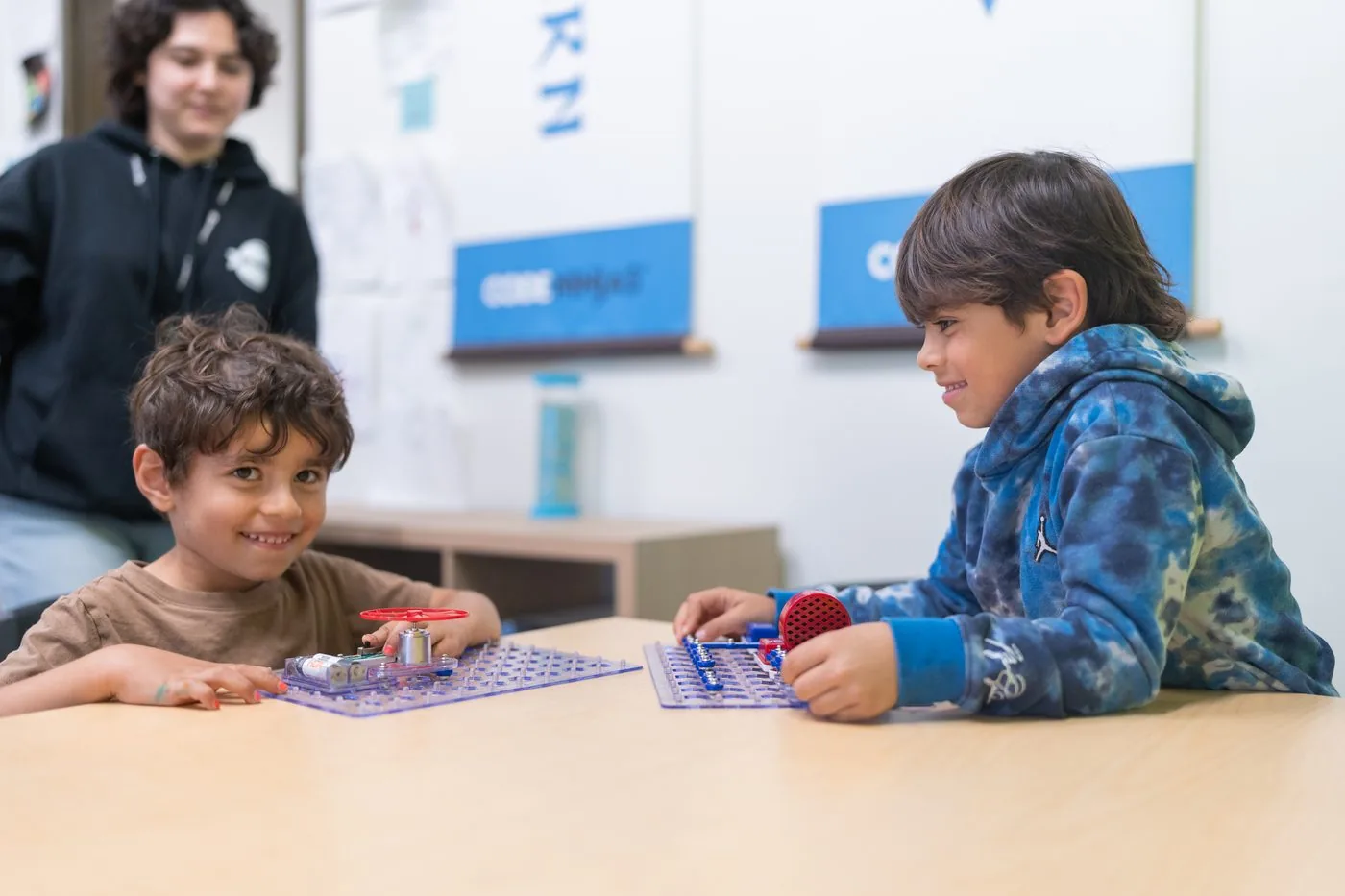
Kids learn to build a machine, program it, and work out why it did not do what they meant. Along the way they practice sequencing, loops, conditions and problem solving, with feedback they can see in the room.
A robot is a great teacher because it is completely honest. If the code says turn left too early, the robot turns left too early, and everyone at the table can see it.
What a class usually builds
Projects get harder in a natural order. In our Robotics Academy that looks like this:
- A drive base. Easy to build and hard to control. Getting it to travel a set distance and stop is the whole lesson.
- A grabber. Motors, gears and a claw, plus the code to open and close it at the right moment.
- A machine that reacts. Distance and color sensors let a robot stop at a wall or follow a line.
- A robot of their own design. A problem to solve, and the kit to solve it however they choose.
The skills underneath
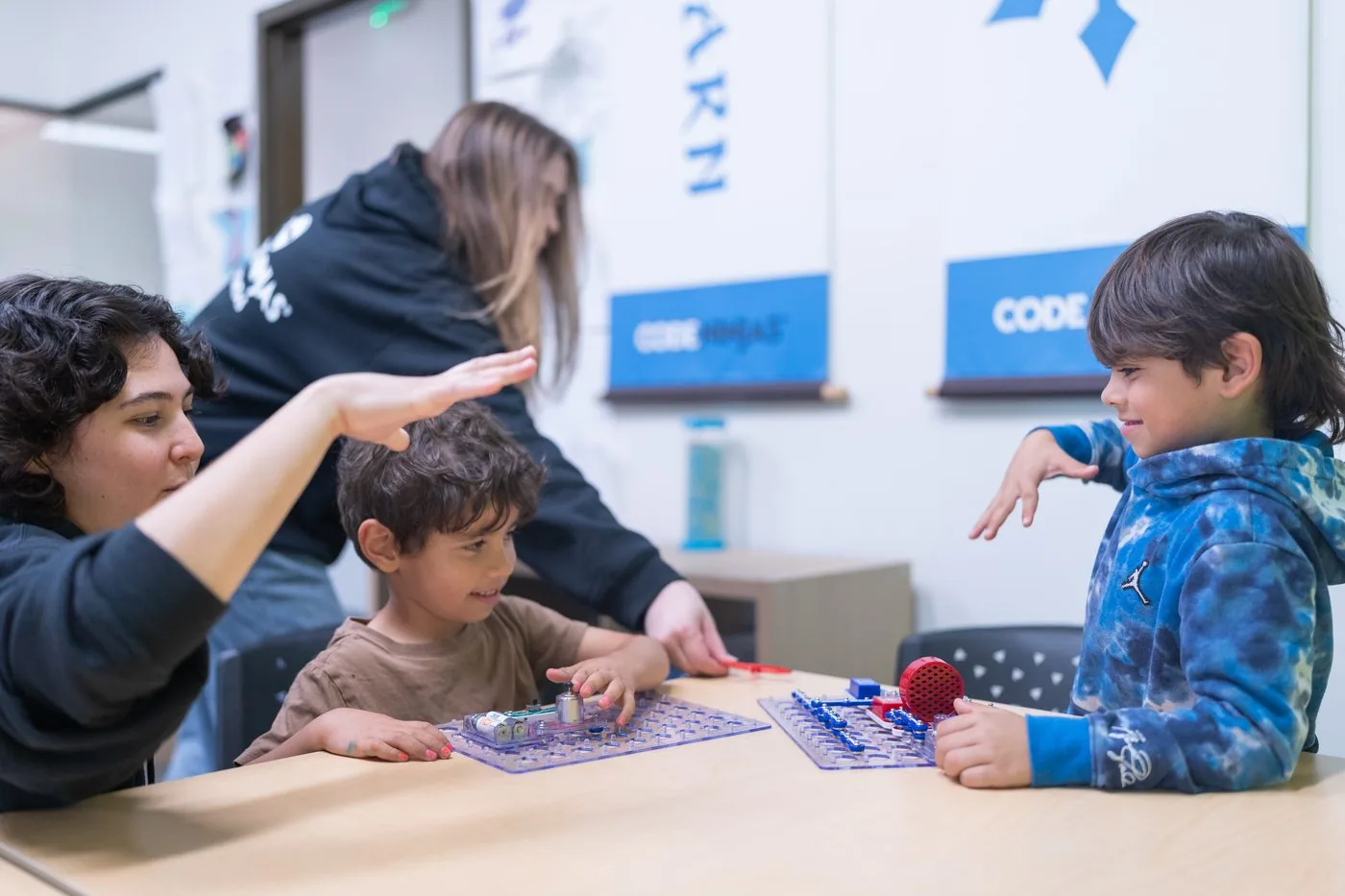
- Sequence and repetition: a robot does exactly what it is told, in order, and loops keep that manageable.
- Conditions: if the distance reading is under ten, stop. Sensors are where real logic begins.
- Engineering: how structure, gears and motors change what a machine can do.
- Debugging: testing an idea, seeing what happened and changing one thing at a time.
What the research says
The evidence is encouraging, with some limits worth knowing. A 2024 meta-analysis of 10 studies in the journal Heliyon found a positive effect from robotics on computational thinking in early childhood. It covers children up to age 6, and its authors note signs of publication bias, because nearly all the published results were positive.
What to ask about a robotics class
- Does my child write the code? Look for a class where they program the robot themselves, as well as build it.
- Does every child get hands on the kit? Ask how the kits are shared during a class.
- Is there a path forward? A class that keeps going gives a child something to grow into.
- Do we need to buy anything? Check whether kits are provided.
How our Robotics Academy works
It is a weekly class for ages 5 to 14, taken alongside a core membership. There are 97 lessons across four kits: VEX GO, LEGO SPIKE Essentials, LEGO SPIKE Prime and Ozobot Evo. A sensei starts each ninja on the kit that suits them, and everything is provided at the studio.
Common questions
What age can kids start robotics?
Our Robotics Academy takes ages 5 to 14, and a sensei starts each ninja on the kit that suits them.
Does my child need coding experience for robotics?
Robotics runs alongside a core membership, so a ninja doing robotics is doing Junior or Create too.
Do we need to buy a robotics kit?
No. Everything is provided and stays at the studio.
How long does the program take?
There are 97 lessons across the four kits, at one class a week, so it is a program a ninja stays with over time.
 Getting started
 Camps
 AI